

AI development services that run in production.
Discuss the task, permitted data, model options, evaluation criteria and approval steps before committing to an AI build.
What we build with AI.
Five kinds of AI work, each with its own page. Most projects combine two: an assistant grounded in your data, and an agent that acts on what it finds.
AI agent development
Agents that plan, call your tools and hand off to people when unsure.
Generative AI development
Text, image and document generation built into your product.
LLM integration and RAG
Language models wired into your systems and answering from your documents.
AI chatbot development
Customer and internal assistants that answer from your own data.
AI consulting
Use-case selection, data readiness and governance before you build.
How we take AI to production.
An AI feature needs more than a model. Its evaluation, access controls, operating cost, observability and review steps need to be designed together.
Evals before launch.
We build a test set from real tasks first, then measure every prompt, model and retrieval change against it. Nothing ships on a demo that happened to work once.
Guardrails on every output.
Inputs and outputs are checked for policy, personal data and answers outside the system's scope. Uncertain answers go to a person instead of the user.
Costs capped per request.
Each feature carries a token and hosting budget, with model routing so routine requests use cheaper models. You see the cost per answer before go-live.
Your data stays yours.
Review model-provider terms, training use, processing locations and retention. Agree endpoints and access controls against the data requirements of the engagement.
Observable from day one.
Every request is traced: what was retrieved, which tools ran, what it cost and how long it took. Quality drifts get caught on a dashboard, not by a customer.
People where judgement matters.
Review steps for anything with legal, financial or clinical weight, and a clear handover path. The system does the volume; your team keeps the decisions.
See it work
Which AI approach fits your problem?
Five yes-or-no questions. We'll point you to the pattern that fits, and the page that explains how we build it.
Sample data, scripted to show how the system behaves. Your version runs on your data and tools.
Book a 30-min callReference architecture
Explore an illustrative planning workflow.
Select a step to see a design question. The actual architecture, controls and deliverables depend on the project.
Illustrative sequence: define the task, test a design, plan its use.
Shape · step 1 of 4
Use case and metric
State the task, the current baseline and the criteria by which a proposed change would be assessed.
- Planning consideration
- Task and evaluation criteria
AI work we've shipped.
Case studies where a model does part of the job. We anonymise clients by default and share details under NDA.
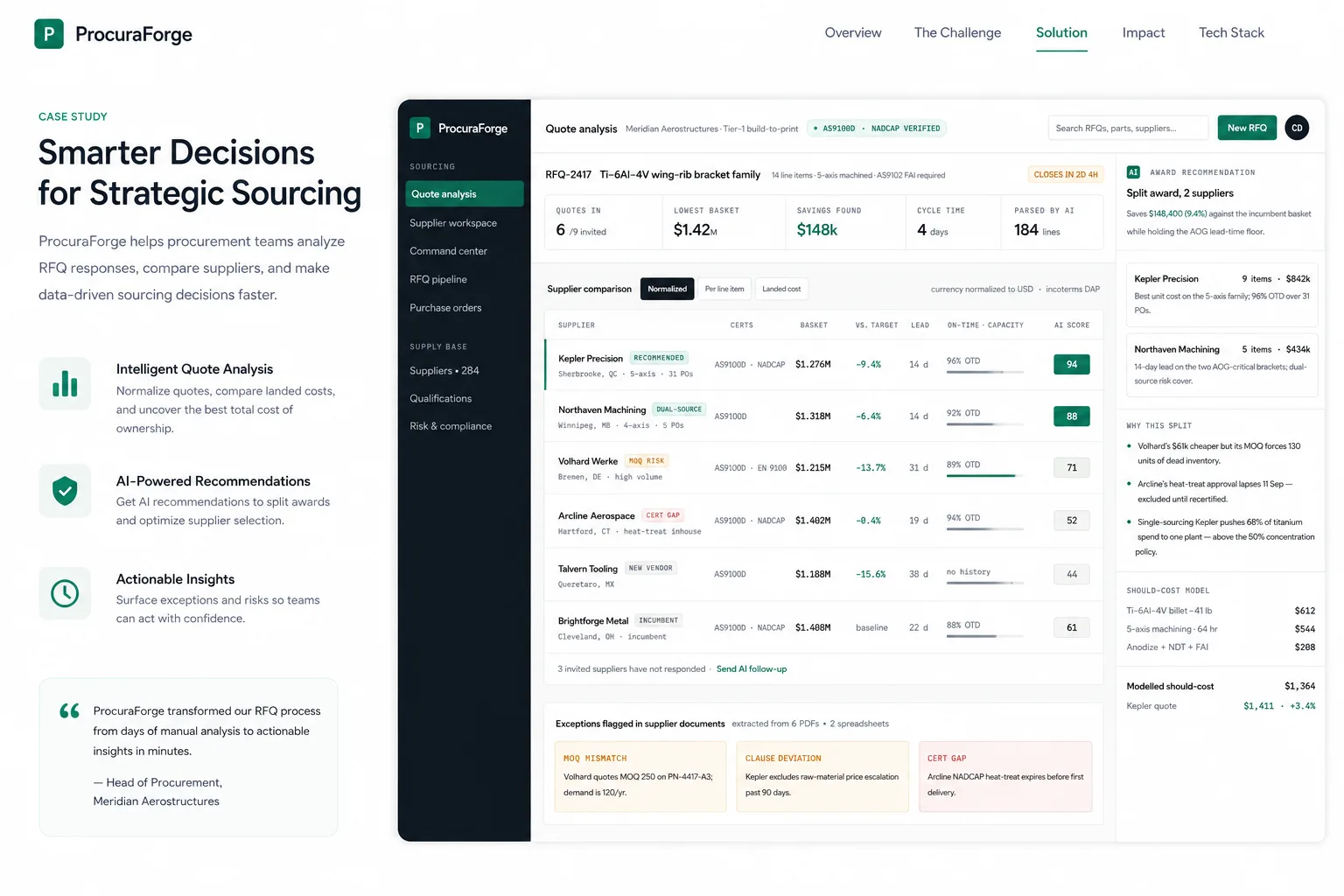 Anonymised case studyIndustrial
ProcuraForge: AI procurement automation.
A single source of truth for POs, commitments and supplier conversations.
React · Django REST Framework · PostgreSQL
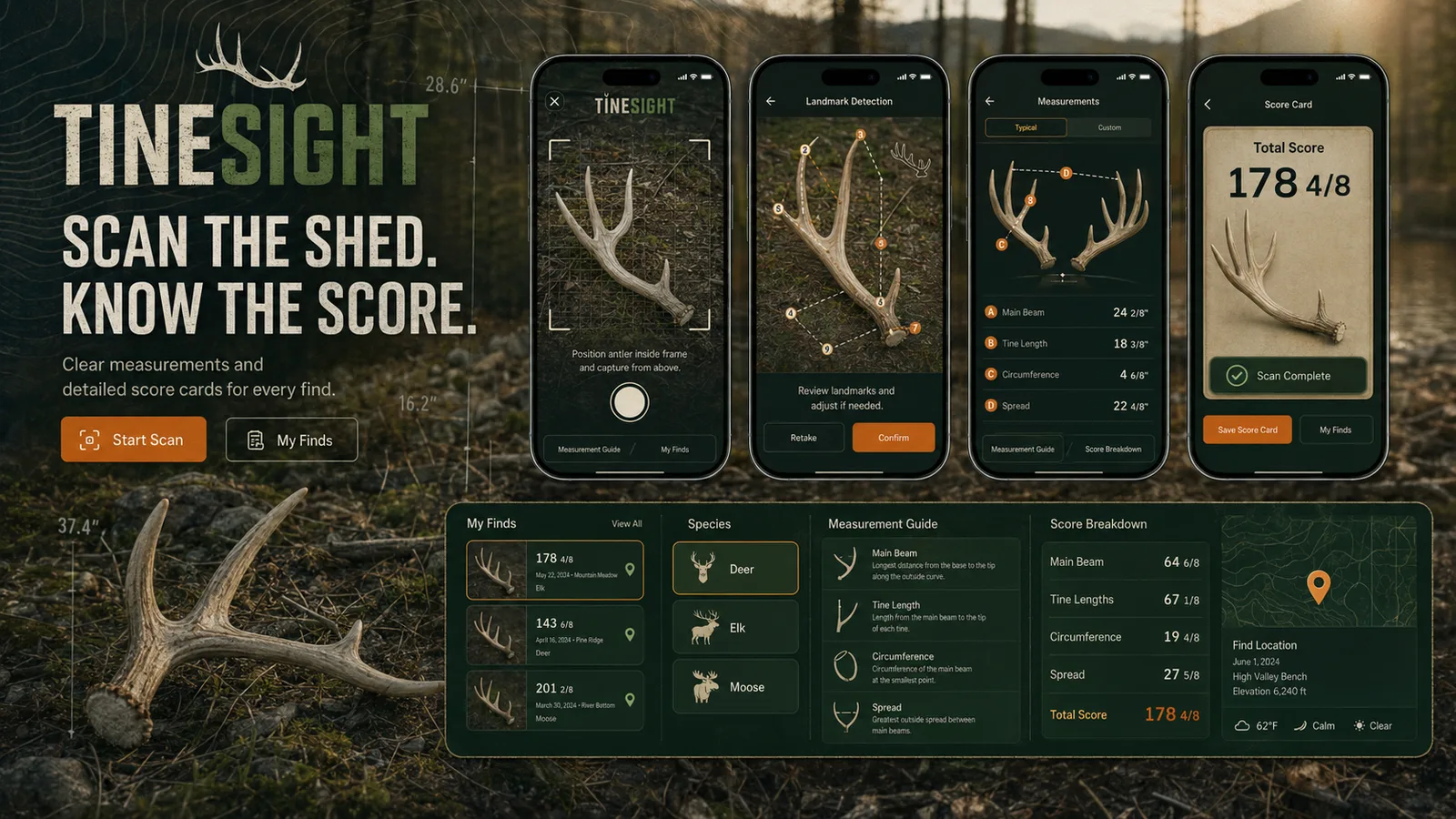 Anonymised case studyCommerce
Shed Happens: photo-score shed antlers.
A collector photographs a find and gets a measured, scored result instead of working a paper card by hand.
React Native · Computer vision · Django · Django REST Framework
AI in the sectors we serve.
Where AI earns its place differs by industry. These are the systems we build most often in each.
Financial services
Document review, KYC checks and analyst assistants over policy and filings.
Healthcare & life sciences
Triage support, clinical letter drafting and patient-facing assistants with human sign-off.
Retail & commerce
Product search and recommendations, catalogue copy at scale and support assistants.
Logistics & mobility
Document extraction for shipping paperwork and exception-handling agents.
Telecom & media
Content tagging and summarisation, subscriber support and churn signals.
Energy & climate
Field-report extraction, asset-data assistants and regulatory reporting drafts.
Public sector
Casework assistants, correspondence drafting and accessible citizen services.
Education
Tutoring assistants, marking support and course content generation.
Manufacturing & industrial
Maintenance assistants over manuals, quality inspection and procurement automation.
Real estate & PropTech
Listing generation, lease abstraction and tenant assistants.
Travel & hospitality
Booking assistants, itinerary generation and guest messaging in several languages.
Legal & LegalTech
Contract review, clause extraction and research over your own precedents.
HR & workforce
CV screening support, policy assistants and job description drafting.
Questions before an AI build.
Still wondering something? Ask an engineer
Describe the task, its current workflow, the available data and the consequences of an incorrect answer or action.
No. The proposed feature needs evaluation against representative tasks, explicit failure handling and appropriate review. Test results and remaining limitations should be recorded before release.
Those conditions depend on the selected provider, product, region, settings and agreement. Confirm them against the applicable terms before supplying data.
Share the scope, constraints and required skills. Availability, milestones, fees and any support arrangements need to be confirmed in a project-specific proposal.
Ownership, licences, repository access and handover terms are governed by the project agreement. Third-party software and content may have separate licence terms.
Discuss your software project.
Describe the workflow, existing systems and the change you need. Use the enquiry form to discuss scope and next steps.