
AI agent development
that ships work.
Autonomous agents, multi-agent systems, retrieval pipelines, and tool-using LLM stacks. We wire in evals, guardrails, and cost controls before launch. Built to run in production, not on a keynote stage.
Agents that do work, not flashy demos.
Most agentic-AI work in the wild is a prompt, a chain, and a deployment prayer. We build it differently. Every agent we ship runs through eval harnesses against real task traces. Each run carries a cost budget, tool calls hit a guardrail, and a human-in-the-loop escape hatch catches the cases the model gets wrong.
We've built production agents for customer support triage, document processing, research synthesis, code review, and internal-ops copilots. The pattern repeats. Measure first. Scope the action space tightly. Instrument everything. Ship behind feature flags with a rollback path.
See it work
Watch an agent work a task.
A replay of an agent chasing an overdue invoice: every thought, tool call, check and cost, and a pause for your approval before it contacts the customer.
Sample data, scripted to show how the system behaves. Your version runs on your data and tools.
Want this on your data? Request a callReference architecture
How a production agent is built.
A reliable agent is a controlled loop: it reasons about the next step, calls a tool, observes the result and repeats, inside budgets and permissions, with people approving the actions that matter.
Pattern Tool-calling agent loop (reason, act, observe) with plan-and-execute and human-in-the-loop
The agent loop · step 1 of 7
Trigger
A ticket, email, form or schedule starts the run with the task and the context the agent may see.
- Standard practice
- Event-driven task intake
- Typical tools
- WebhooksQueuesTemporal
- You get
- A logged run with its inputs
Shipped under this discipline.
A sample of projects where this capability was load-bearing. We omit client names by default and share them under NDA when you want to dig into a specific engagement.
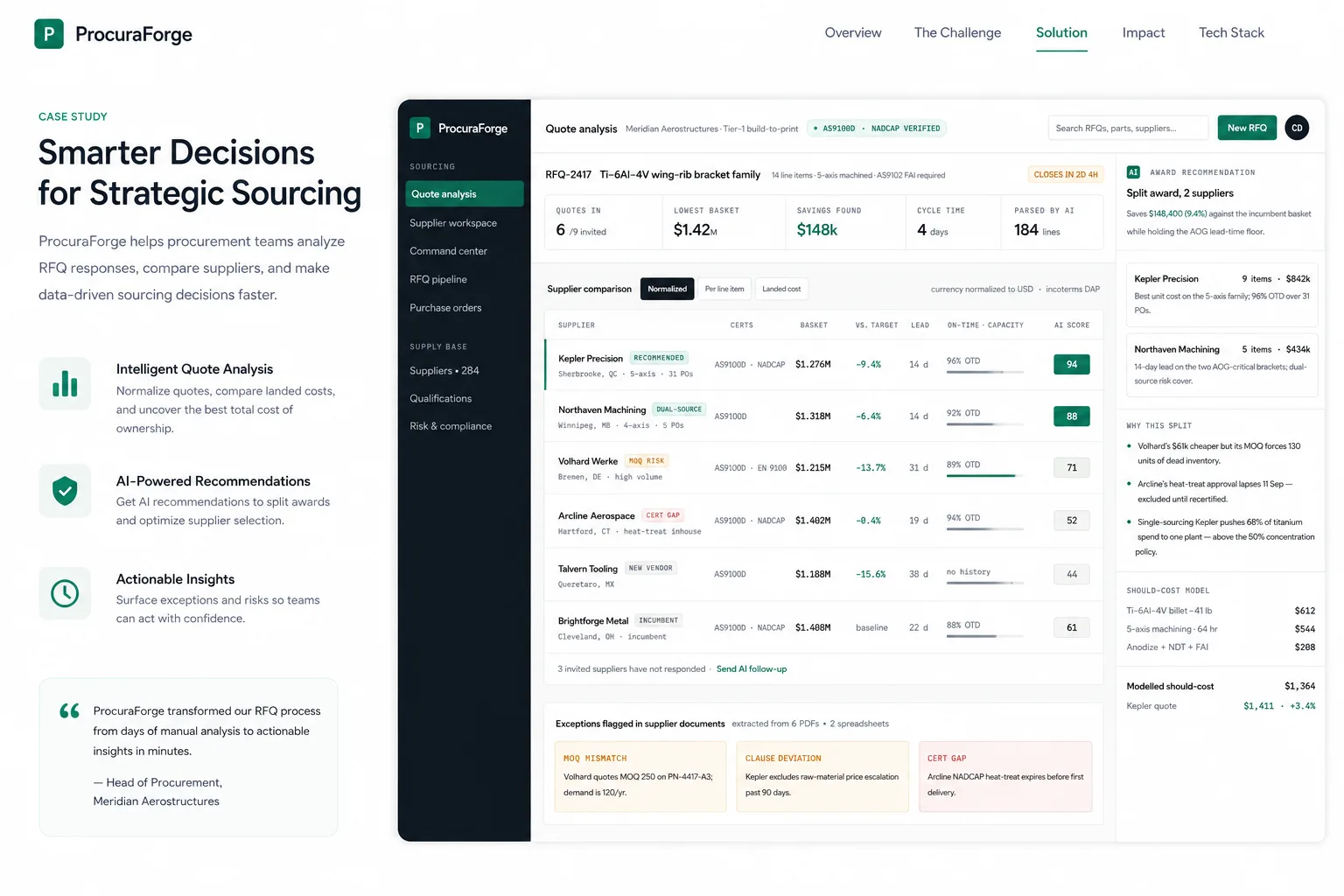 Manufacturing · North America
ProcuraForge: AI procurement automation.
A single source of truth for POs, commitments and supplier conversations.
React · Django REST Framework · PostgreSQL
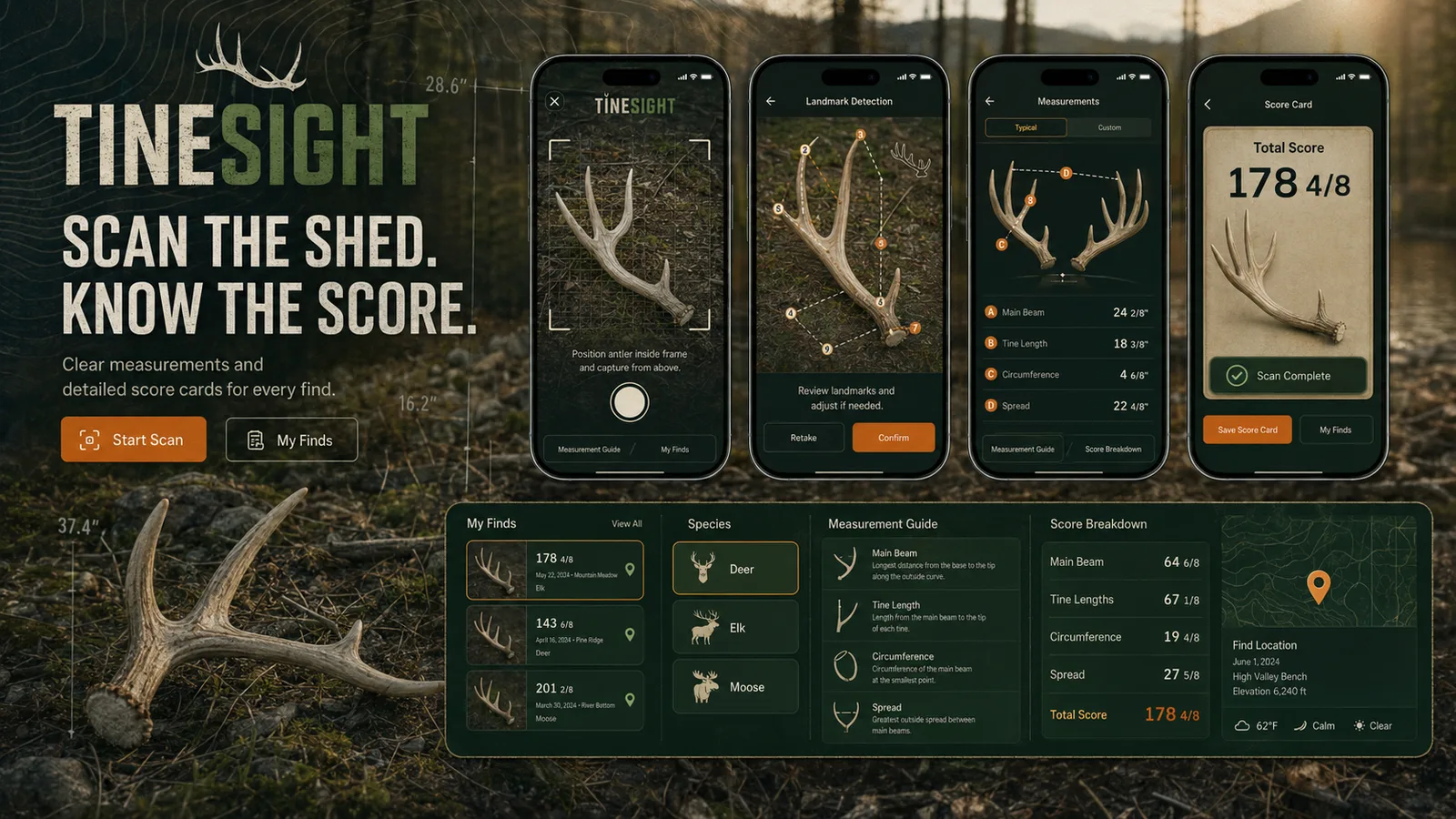 Retail · North America
Shed Happens: photo-score shed antlers.
A collector photographs a find and gets a measured, scored result instead of working a paper card by hand.
React Native · Computer vision · Django · Django REST Framework
From single-task agents to fine-tuned models.
Most engagements are a mix of two or three of these. We scope the exact cut during discovery and write the evaluation plan into the statement of work.
Task-specific agents.
An agent that reliably finishes one job, instead of impressively half-doing many. Single-purpose agents that complete a bounded workflow, triage a ticket, draft a reply, extract fields from a document, with scoped action spaces, narrow tools, and high reliability.
Multi-agent orchestration.
Coordinated agents that get complex work done without going off the rails. Planner/worker topologies, DAG-driven pipelines, and handoff protocols between specialised agents, built on AutoGen, CrewAI, LangGraph, or bespoke orchestrators when the frameworks don't fit.
RAG and retrieval pipelines.
Answers grounded in your data, with citations you can actually check. Hybrid retrieval, re-ranking, chunking strategies, and freshness controls, evaluated on grounding and citation quality rather than vibes.
Tool-using copilots.
An assistant that safely acts in your systems, not just chats about them. Agents that call your APIs, query your databases, and drive your internal tools, with permission boundaries, audit trails, and cost caps per session.
Eval harnesses and observability.
Know your AI still works after every prompt change, before your users find out. Production-grade evals with golden datasets, regression tracking, and prompt-change review gates, plus tracing, cost dashboards, and alerting on drift.
Fine-tuning and distillation.
Better quality or lower cost when prompting hits its ceiling. LoRA, QLoRA, full fine-tunes, or distillation into cheaper models, measured before and after rather than asserted.
Scoping agentic AI development? Get an engineer's read on your build in 30 minutes — no sales pitch, no decks.
Start a projectA pragmatic agentic stack.
We pick models and frameworks to fit the task and budget, not the trend cycle. The tools our engineers ship with most often:
Pick the engagement model
that fits the commitment.
The same agentic AI development work ships under any of these three commercial shapes. The difference is in how you hold us accountable and how you scale up or down.
More AI services.
Each kind of AI work has its own page. Most projects combine two: an assistant grounded in your data, and an agent or integration that acts on it.
Explore AI development- Generative AI developmentText, image and document generation built into your product.
- LLM integration and RAGLanguage models wired into your systems and answering from your documents.
- AI chatbot developmentCustomer and internal assistants that answer from your own data.
- AI consultingUse-case selection, data readiness and governance before you build.
Before you commission an agent.
Can't find what you're looking for? Email hello@cloudini.co and we'll reply within one working day.
An agent is an LLM-powered system that chooses actions to complete a task autonomously. It calls tools, queries data, writes files, sends messages. A chatbot answers. The engineering challenge is two-fold: constrain the action space tightly enough that the agent stays reliable, and instrument it well enough that you can tell when it isn't.
Three layers. Grounding (retrieval, tool calls, structured outputs). Guardrails (schema validation, allow-lists, rule engines for high-stakes outputs). Evals (golden datasets, regression tests, human review for edge cases). We ship with all three. We also build a rollback path so you can recover when the model changes behaviour after a provider update.
We treat cost as a first-class engineering constraint. We route tasks to the cheapest model that passes evals, cache aggressively, batch when latency permits, and set per-tenant budget caps with circuit breakers. Every production agent has a cost dashboard. Unusual spend triggers alerts before the invoice does.
Depends on the task. We benchmark 2 to 3 candidates against your eval set before committing. For complex reasoning we typically start with Claude Opus or GPT-5. For high-volume classification we drop to Haiku, Sonnet, or a fine-tuned open-weights model. We stay model-agnostic by design so the architecture won't lock you to one provider.
Yes. That's usually where the value sits. We build retrieval pipelines over your knowledge base, wire agents to your internal APIs with scoped credentials, and respect your permission model so the agent can't see data the user couldn't. Zero-trust by default.
Input filtering, prompt-injection defences, output moderation, rate limits, and audit logging. For customer-facing agents we run a red-team pass before go-live. For internal copilots we stage rollouts by user cohort. We fix safety issues before the next release instead of documenting them as known issues.
Custom software is the broader discipline. Backends, data, integrations, internal tools. Agentic AI is a specialisation within it, with its own evaluation practice, cost economics, and failure modes. Many engagements combine both. An agent is usually one feature in a larger custom-software system.
One of their strengths is quickly building out a multi-disciplinary team to work on the development and delivery of features with different technical requirements. Their support has allowed us to accelerate our development work without building an internal team. They have also worked seamlessly with other third parties both during the acquisition of Dragonfly and development of our mobile app.
Let's build from here.
Thirty minutes with an engineer who builds. No sales, no drip campaign. If we're the wrong fit we'll tell you and point you somewhere better.